Jets and Sharks arrange a duel
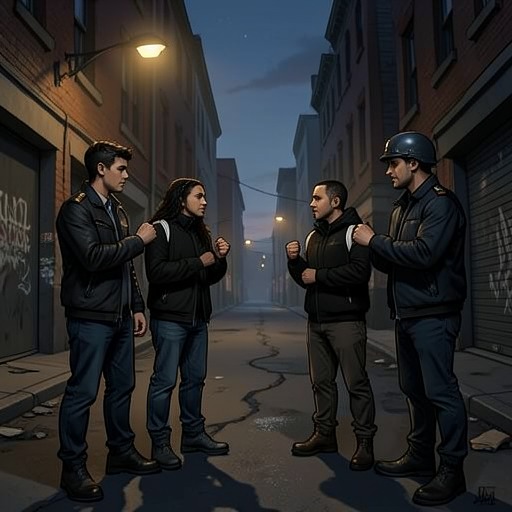
West Side StoryJets and Sharks arrange a duel when Riff Lorton challenges Bernardo to settle their conflict through a fight. Their exchange converts a brewing confrontation into a specific appointment: the following night, beneath the highway, under rules the leaders will set. But the agreement is made in a snack bar already watched by the police, and Lieutenant Schrank’s arrival interrupts the meeting before every practical term is resolved.
Background and Pressure
The arrangement takes shape inside the snack bar, where the bartender reminds the Jets to keep their promise not to cause trouble. He points out that the public telephone is at the front, a small detail that makes the entrance and the street part of the immediate scene. Riff Lorton does not answer. Instead, he locks the front door and checks outside for Tony Wyzek. Tony is nowhere in sight, and Riff recognizes that if Bernardo intends to begin the confrontation that night, the Jets will have to respond without him.
That absence shapes Riff’s next move. He directly challenges Bernardo, framing the proposed fight as a way to end the dispute once and for all. Bernardo accepts the challenge, but does not treat acceptance alone as enough: he asks what the rules will be. The exchange shifts the conflict from a threat into negotiation. Both leaders are now deciding not only whether a fight will happen, but how their rival groups will conduct it.
Setting the Terms
Riff answers Bernardo’s question by opening his hands and saying that the Jets have decided to let the Sharks choose the rules. Pepe objects that the Jets started the trouble, keeping responsibility for the conflict in dispute even as the two leaders proceed. After Riff steps between the men when tempers rise, he asks Bernardo to give a definite answer. Bernardo confirms that the Sharks accept, then asks when the encounter should take place.
Bernardo proposes the following night. Riff is pleased by the delay because it gives him time to find Tony Wyzek. He reaches out to Bernardo to seal the commitment, both formalizing the agreement and presenting himself to the Jets as a leader able to make terms with their opponent. Riff asks whether the fight should take place in the park or by the river. Bernardo proposes beneath the highway, and the two shake hands on that location. Riff signals that he accepts the choice. The handshake makes the appointment concrete: this is no longer only an exchange of insults, but a mutually acknowledged plan.
A Duel, Not Yet Fully Defined
Agreement on a time and place does not settle every question. Riff asks what weapons the groups will use, and the discussion later turns toward who will represent the Jets. When Pepe protests that Bernardo’s proposal would leave the rest of the Sharks watching, Bernardo’s answer makes clear that the leaders’ decisions govern whether their followers participate. Action rejects the idea of standing aside, striking his empty coffee cup against the counter and objecting especially to the prospect of watching a particular man. Riff cuts him off and characterizes the proposed encounter as a fair fight, asking Bernardo to confirm the understanding.
Bernardo does not immediately shake hands again; he says his word is enough. He then challenges the delay, arguing that they could fight at once, and directs his challenge toward Tony Wyzek, who is present. Riff counters by naming Diesel as the Jets’ best man and reiterating that the following night suits them. Bernardo points toward Tony, visibly disappointed by Riff’s substitution. Action offers to take over if Bernardo changes his mind, but Riff rebukes him and sends him to open the door. The exchange exposes a difference between the broad agreement and its unresolved particulars: the leaders have fixed the time and place and invoked a fair fight, but the cited exchange does not provide a final answer to the weapons question. It also shows that Tony’s presence matters to Bernardo, even though Riff does not select him as the Jets’ representative.
Schrank’s Interruption and the Agreement’s Significance
Before the gathering can continue, Lieutenant Schrank enters the snack bar. The bartender returns from the back room and looks displeased at finding the groups and the officer together. Schrank reaches over the counter for a nearly full packet of the bartender’s cigarettes, then addresses the gathering with contempt. He has noticed that Riff kept Bernardo from advancing toward him, and takes this as confirmation of what Glad Hand had told him: the men are holding a war council and intend to fight.
Schrank orders Bernardo and the Sharks out. He couches the order in the language of law, acknowledging that he cannot simply command them to leave a free country, then invokes his badge and threatens the consequences of defying him. The Sharks file out together around Bernardo. Before Krupke can get out of the patrol car, they separate and scatter in different directions, preventing the police from following them as a group. Schrank remains with Riff and asks where the fight is planned, extending the pressure beyond the immediate meeting.
The scene’s decisive result is therefore both an agreement and an interruption. Riff and Bernardo establish the duel’s central coordinates—the following night and the ground beneath the highway—and describe it as a fair fight, while rivalry over who will face whom remains visible. The police do not dissolve the hostility; Schrank’s intervention disperses the Sharks without undoing the leaders’ words or handshake. The scheduled contest emerges from a negotiation conducted under threat, with the public setting and the officer’s arrival showing how little privacy or control the gangs have over their confrontation.